


Materials & Environmental Impact
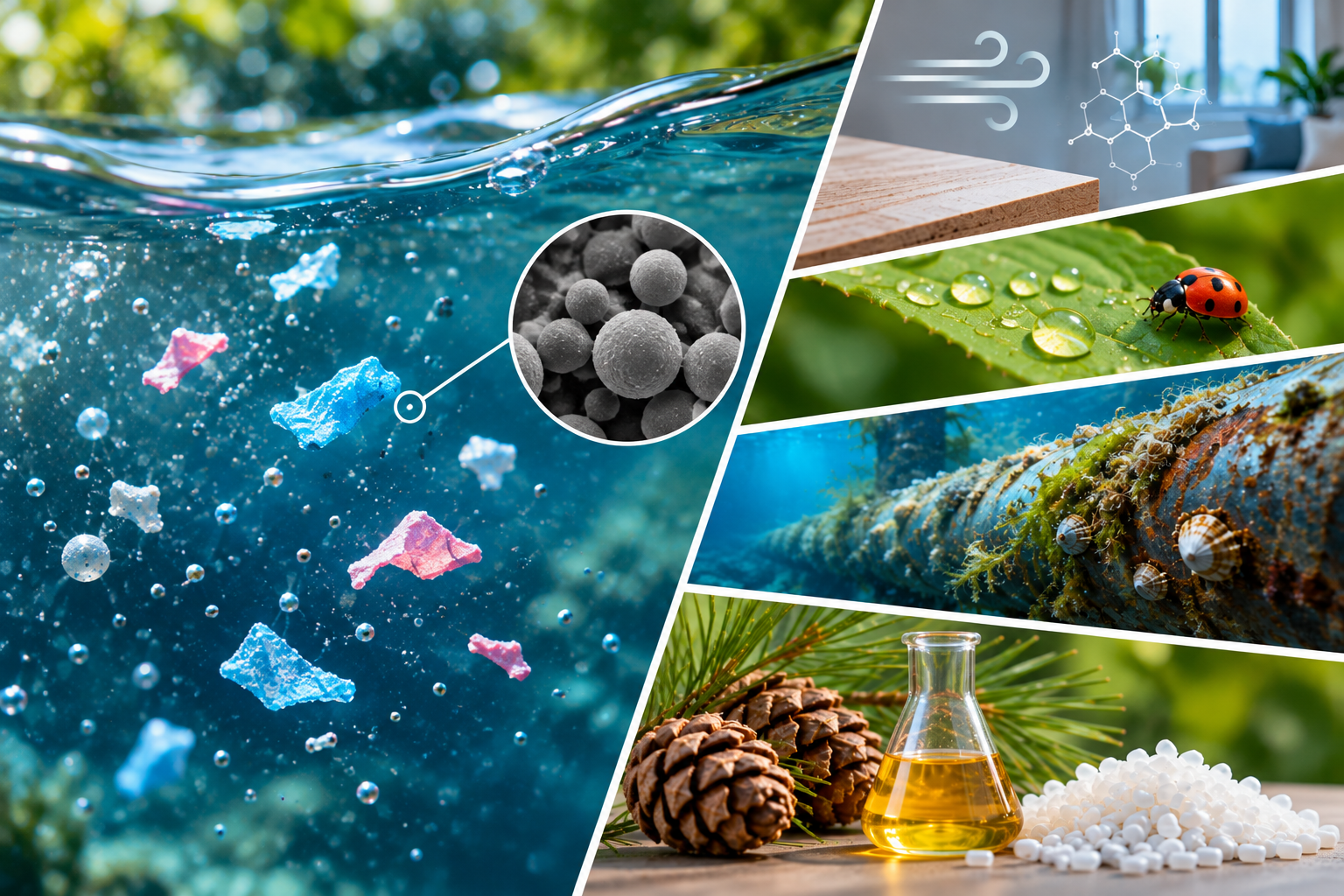
IPREM investigates the interactions between materials and the environment, combining polymer chemistry, surface characterization and environmental analysis within a One Health approach.
Research focuses on the environmental fate and biological impacts of nanoplastics, emerging pollutants, sustainable pest management, biocorrosion and the development of bio-based polymers. These activities contribute to understanding environmental risks and designing more sustainable materials and technologies.
IPREM has developed internationally recognized expertise in the tailored synthesis of model nanoplastics, including isotopically, fluorescently and metallically labelled particles, to investigate their transport, environmental fate and interactions with living organisms.
Combining polymer surface engineering with advanced characterization techniques such as XPS, ToF-SIMS and Auger electron spectroscopy, these studies provide detailed insights into the physicochemical properties and behaviour of nanoplastics in complex environmental matrices.
In collaboration with the CAPT and CME research clusters, this multidisciplinary approach has enabled the quantification of nanoplastics at very low concentrations and the assessment of their impacts on freshwater and marine organisms, including sea urchins.
This expertise has contributed to international initiatives on nanoplastics standardization and risk assessment through the OECD, as well as science–policy discussions within the United Nations Environment Programme (UNEP) on the global plastics pollution treaty.
IPREM investigates the long-term emission kinetics of semi-volatile organic compounds (SVOCs), including phthalates and flame retardants, from furniture and indoor materials.
These studies have demonstrated the role of material surfaces as persistent reservoirs of contaminants, influencing their release and redistribution in indoor environments.
To better characterize these processes, researchers have developed a miniaturized on-site emission cell (Midget cell) coupled with solid-phase microextraction (SPME). This approach enables the investigation and quantification of gas–surface partitioning equilibria for volatile and semi-volatile organic compounds (VOCs and SVOCs), contributing to improved assessment of indoor air quality and human exposure.
IPREM develops innovative analytical methods and transport models to investigate the spatial and temporal diffusion of pheromones used in agroecological pest management.
By improving the understanding and control of pheromone release and transport, these studies address major challenges in the development of effective and sustainable biocontrol strategies.
This research provides environmentally responsible alternatives to conventional pesticides and contributes to the One Health approach by reducing chemical inputs while supporting agricultural sustainability.
IPREM investigates environmentally friendly strategies to prevent microbial colonization and biocorrosion of materials in marine environments.
Research has demonstrated the protective effectiveness of chitosan-based coatings against colonization by the marine bacterium Nitratidesulfovibrio vulgaris, highlighting the potential of bio-based surface treatments.
These results have attracted interest from major international industrial partners, including Safran and Tarkett, leading to collaborative efforts to develop durable and environmentally responsible surface protection solutions.
IPREM develops sustainable polymer materials from terpene-derived molecules obtained from pine biomass, contributing to the substitution of fossil-based chemical feedstocks.
Research focuses on the synthesis of amphiphilic copolymers capable of acting as efficient emulsifiers for oils and particles, providing alternatives to conventional fluorinated and ethoxylated surfactants.
By combining renewable molecular building blocks with controlled polymer synthesis, these developments contribute to the design of functional materials with reduced dependence on petroleum-derived resources.