


Energy Storage & Conversion Materials
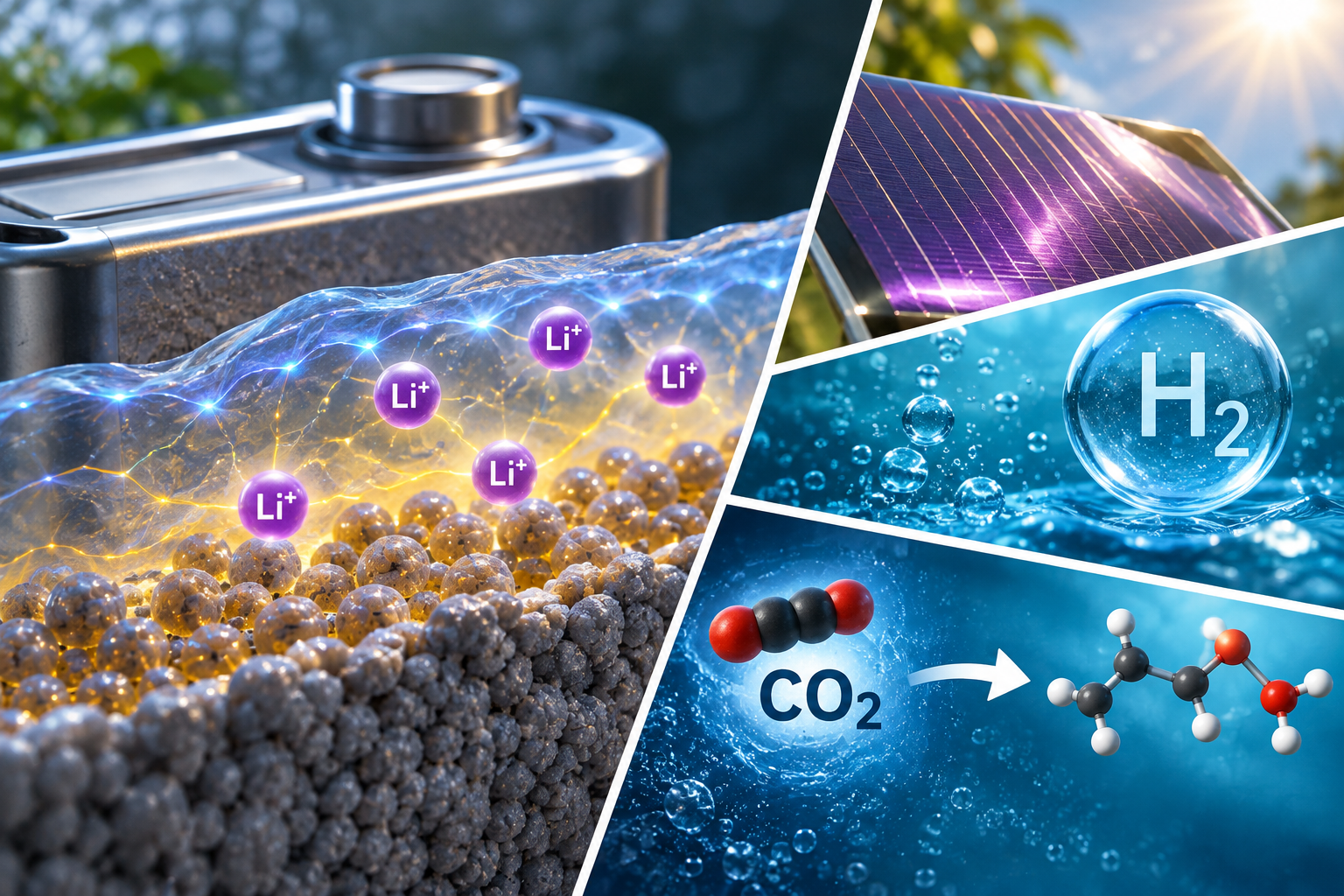
IPREM develops advanced polymer materials, functional interfaces and innovative characterization methods to address major challenges in energy storage and conversion.
Our research focuses on battery interfaces and solid polymer electrolytes, sustainable organic photovoltaics, solar hydrogen production and electrochemical CO₂ conversion. By combining controlled polymer synthesis, surface engineering and operando characterization, these approaches contribute to more efficient and sustainable energy technologies.
IPREM investigates electrode–electrolyte interfaces in lithium-ion and post-lithium-ion batteries, focusing on interfacial stability, degradation and ageing mechanisms. Advanced operando surface characterization methods, including Auger electron spectroscopy and near-ambient-pressure X-ray photoelectron spectroscopy (XPS), provide insights into solid electrolyte interphase (SEI) formation and passivation processes. These developments have enabled pioneering studies of lithium/solid-electrolyte interfaces, all-solid-state organic batteries and potassium-ion battery systems.
IPREM develops nanostructured solid polymer electrolytes through photoinduced polymerization-induced self-assembly directly on positive and negative electrodes. This in situ strategy enables controlled electrolyte formation and improved electrode–electrolyte contact. Research also explores lithium-containing precursors and hybrid polymer formulations to design innovative solid electrolytes for next-generation battery technologies. These developments have led to patented electrolyte compositions.
IPREM develops environmentally responsible aqueous inks based on conjugated polymer nanoparticles, replacing conventional toxic organic solvents in organic photovoltaic device fabrication. Controlled nanoparticle architectures, including Janus, intermixed and core–shell morphologies, enable precise engineering of donor–acceptor domains. These advances have achieved power conversion efficiencies exceeding 10% in aqueous-processed organic photovoltaic systems, demonstrating the potential of sustainable manufacturing strategies.
IPREM investigates the production of solar hydrogen using water-dispersed conjugated polymer nanoparticles as photocatalysts. Building on research conducted within the European eSCALED project, these studies explore innovative strategies for improving light-driven hydrogen generation, including the integration of bio-inspired iron-based catalysts into functional polymer architectures. The objective is to develop efficient materials and systems for sustainable solar fuel production.
IPREM develops advanced catalytic interfaces for the electrochemical reduction of CO₂ and CO into value-added C₂+ compounds. Research combines catalyst engineering, zero-gap electrolyzer configurations and electrode functionalization using structured block copolymers based on polymerized ionic liquids. These approaches improve reaction selectivity and kinetics at high current densities in aqueous media, supporting the development of more efficient carbon conversion technologies.