


Bio-Inspired & Functional Materials
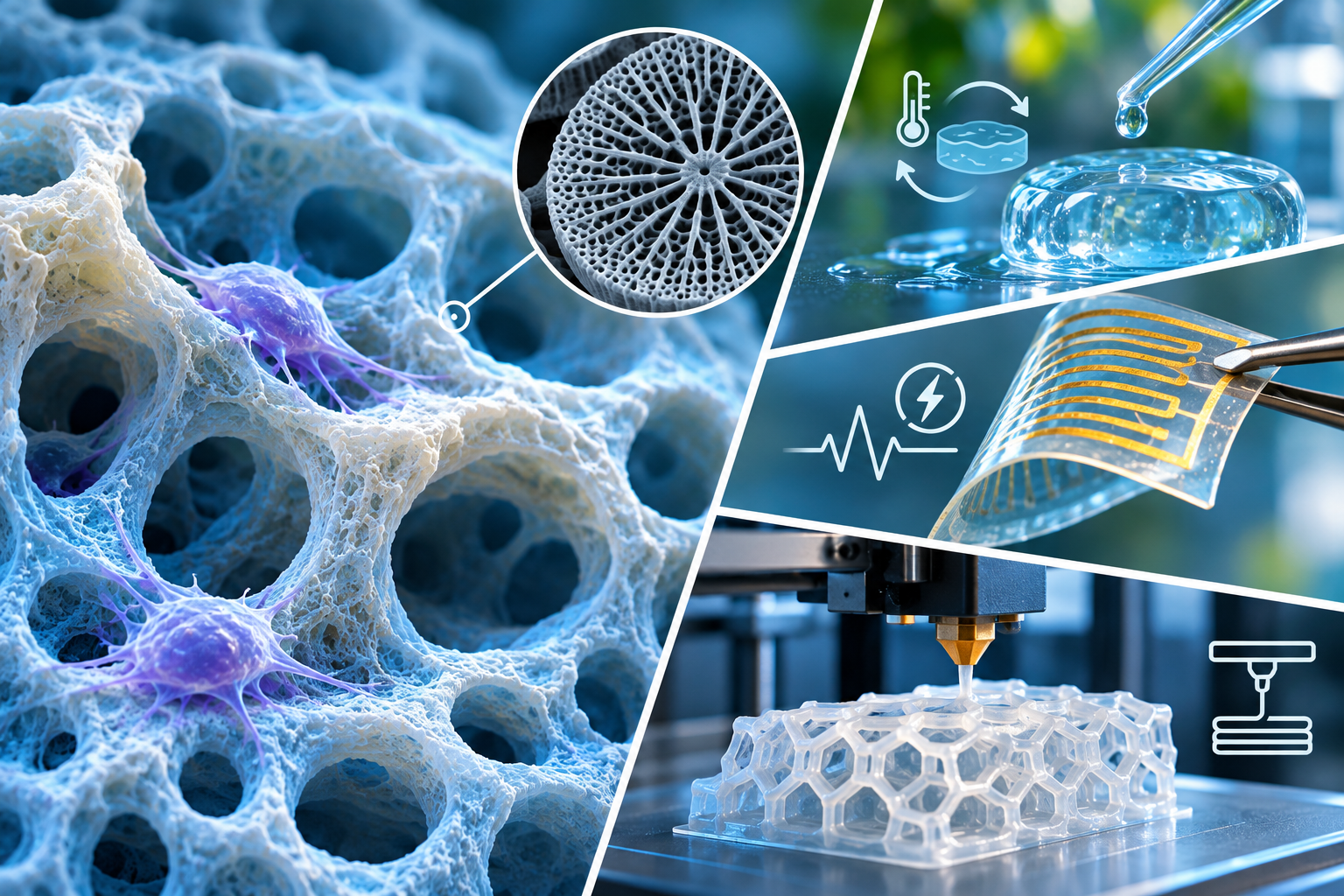
IPREM develops innovative bio-inspired and functional materials by combining expertise in polymer chemistry, biology, surface science and materials engineering.
Research focuses on biomineralization and three-dimensional porous hybrid structures, stimuli-responsive soft materials and adaptive gels, as well as adhesion, viscoelasticity and advanced 3D printing processes. These approaches contribute to the development of materials with tailored mechanical, electrical and biological properties, particularly for biomedical applications.
IPREM develops bio-inspired three-dimensional porous hybrid materials using mild synthesis conditions (soft chemistry) and approaches inspired by natural biomineralization processes.
Research has focused on the design of chitosan/chitin nanocrystal hybrid matrices, inspired by the mineralized structures found in diatom exoskeletons. These materials combine controlled porous architectures with excellent biocompatibility and enhanced osteoconductive properties.
These advances have demonstrated significant potential for bone tissue regeneration, highlighting the value of bio-inspired material design for biomedical applications.
IPREM investigates the design of electroactive soft materials and adaptive polymer systems capable of responding to external stimuli.
Research focuses on the synthesis of self-assembled conductive colloidal microgels in aqueous dispersed media. These materials respond to changes in environmental conditions, particularly pH and temperature, enabling the development of adaptive mechano-electrical transducer films.
These advances have led to several patented developments, including stimuli-responsive conductive colloidal microgels (2022 and 2024), as well as innovations involving native collagen extraction from fish scales (2024) and UV-protective polymers derived from glycosylated mycosporines (2024).
Together, these developments illustrate the potential of functional soft materials and bio-derived polymers for innovative biomedical and technological applications.
IPREM combines advanced rheological and viscoelastic characterization with polymer formulation and processing to investigate adhesion mechanisms and the behaviour of complex materials.
Research includes the study of skin adhesion for healthcare applications and the kinetics of phase transitions in heterogeneous polymer formulations. These investigations support the development of advanced additive manufacturing processes, including fused deposition modelling (FDM) and stereolithography.
Controlled polymerization-induced self-assembly enables the design of structured block copolymer materials across length scales ranging from nanometres to centimetres.
Several patented innovations have emerged from these activities, including automated ex vivo instruments for measuring the rheology and deformation of human skin (2022 and 2024), advanced surgical adhesive formulations (2025), and a textured biodegradable conveyor system designed to optimize methanization processes (2024).