


Contaminant Metabolism & Metal Essentiality
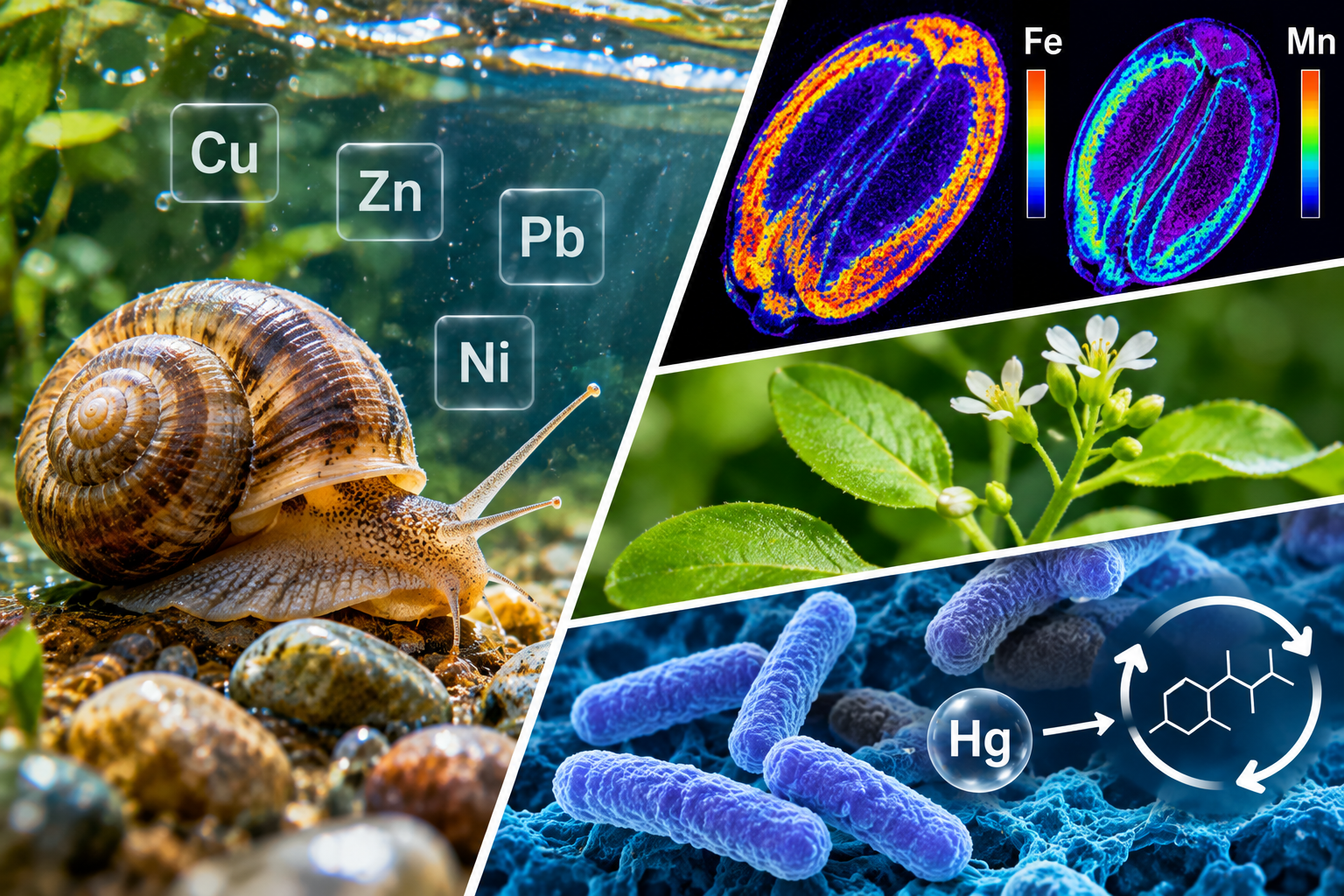
IPREM investigates the biological roles of essential metals and the accumulation, toxicity and detoxification of metallic and organic contaminants in living organisms.
Combining environmental chemistry, molecular microbiology, physiology and advanced imaging techniques, research explores how metals are distributed, acquired and transformed within organisms, and how biological systems respond to contaminant exposure.
These studies provide insights into metal homeostasis, contaminant toxicity and adaptation mechanisms in plants, microorganisms and aquatic organisms.
IPREM investigates the accumulation and distribution of metallic contaminants in aquatic organisms to better understand their environmental exposure and biological effects.
Freshwater gastropods have been validated as bioindicators of metal contamination. Studies have revealed heterogeneous accumulation patterns in their shells, with copper, zinc, lead and nickel preferentially associated with organic fractions, while strontium, barium and manganese are mainly found in mineral fractions.
These results highlight the importance of metal speciation and biological compartmentalization when interpreting contaminant accumulation in living organisms.
By combining chemical characterization with biological observations, this research contributes to the development of reliable approaches for environmental biomonitoring.
Essential metals play fundamental roles in biological processes, but their distribution and functions depend on complex mechanisms of uptake, transport and cellular regulation.
IPREM investigates the localization and biological functions of essential metals, particularly iron and manganese, in plants and microorganisms.
Using multimodal imaging approaches combining synchrotron radiation-based techniques, full-field X-ray imaging and X-ray fluorescence tomography, researchers have mapped the three-dimensional distribution of essential metals in Arabidopsis thaliana seeds.
These studies have revealed distinct spatial distributions of iron and manganese, reflecting their specific biological functions.
In marine environments, where iron availability can limit microbial growth, research has also characterized iron acquisition mechanisms in model bacterial species, contributing to a better understanding of microbial adaptation to nutrient limitation.
IPREM investigates the physiological and molecular mechanisms underlying microbial responses to metallic and organic contaminants, focusing on their toxicity, transformation and detoxification.
Research explores how microorganisms tolerate and transform toxic substances through specific metabolic and cellular processes. Studies on anaerobic bacteria, including Pseudodesulfovibrio hydrargyri, have contributed to understanding mercury detoxification mechanisms.
Complementary investigations have examined the degradation of organic contaminants, particularly alkanes, by aerobic marine bacteria such as Marinobacter nauticus.
By combining microbial physiology, molecular biology and environmental chemistry, these studies provide insights into microbial resistance, contaminant transformation and biodegradation, contributing to a better understanding of the role of microorganisms in contaminated environments.