


Theoretical & Computational Chemistry
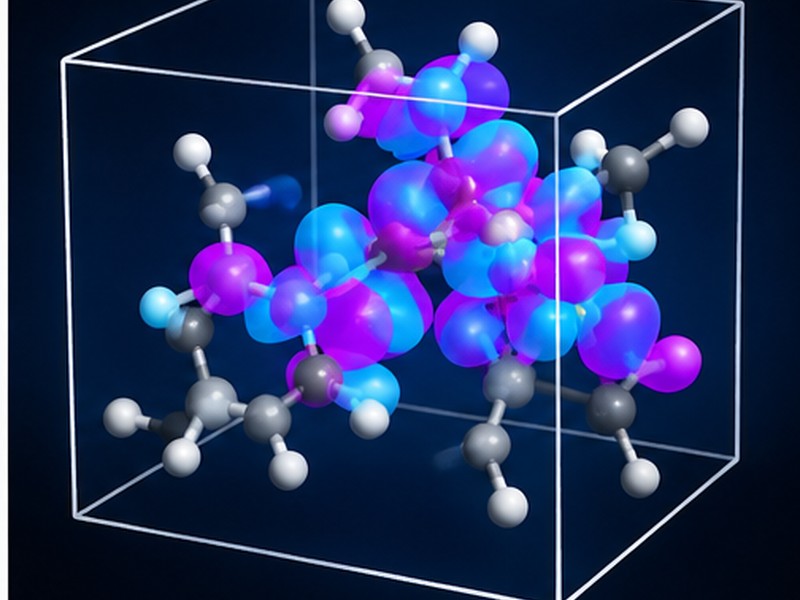
IPREM develops advanced theoretical and computational approaches to investigate chemical reactivity, molecular dynamics and spectroscopic properties.
Our research combines quantum chemistry, reactive molecular simulations and innovative data processing methodologies to improve the description of chemical transformations, vibrational signatures and complex analytical data. These developments contribute to a deeper understanding of molecular processes and enhance the accuracy and reliability of computational and analytical methods.
Development and parameterization of reactive force fields to simulate chemical transformations and bond-breaking and bond-forming processes. A new ReaxFF potential adapted to organochlorine compounds has been developed to investigate their thermal degradation and elucidate reaction mechanisms that are difficult to observe experimentally.
Development and assessment of advanced theoretical approaches to describe molecular vibrations beyond the harmonic approximation. Methods such as canonical Van Vleck perturbation theory (CVPT(4)) and adaptive vibrational configuration interaction (A-VCI) are investigated to characterize anharmonic effects, vibrational resonances and polyad structures in complex molecular systems.
Development of theoretical treatments using valence coordinates to improve the description of molecular vibrational dynamics and spectroscopic signatures. Applications include hydroxylamine, for which advanced computational approaches provide a more detailed understanding of vibrational couplings and experimentally observed spectra.
Development of innovative computational strategies to improve the reliability of complex analytical data. A calibrant-free internal calibration method based on mass-difference analysis has been developed for Fourier transform ion cyclotron resonance mass spectrometry (FT-ICR MS), enhancing the accuracy and robustness of ultra-high-resolution mass measurements.